Gold prices have clawed back above the $5,000 per ounce mark this week after a wild stretch of whipsaw trading, and silver has punched higher following steep swings in early February 2026. Spot gold climbed about 0.9 % to roughly $5,004.61/oz on February 9, buoyed by a softer U.S. dollar and fresh investor interest in safe‑haven assets. Meanwhile, silver has rebounded sharply from recent lows, rising toward the $80+ range after dramatic drops last week.
These moves are grabbing attention because they follow one of the most turbulent few weeks in metals markets in years, with steep sell‑offs, heavy volatility, and rapid rebounds all playing out. The current backdrop is a mix of macroeconomic uncertainty, shifting Fed expectations, and bargain hunters stepping back into precious metals, setting the stage for more big price swings ahead.
Advertisement
Precious Metals Rebound After Turbulent Trading
Global gold and silver markets swung dramatically in the first half of February 2026. Gold has recovered above key psychological support near $5,000 per ounce, while silver has seen a sharp rebound after steep declines. These shifts followed intense volatility driven by macroeconomic data, policy uncertainty, and risk sentiment swings.
Price action on major exchanges showed gold climbing in early Asian trade and holding strong in both international and local markets such as India’s MCX. Silver, which had fallen sharply in recent sessions, bounced back with renewed buying from retail traders and ETF inflows.
Why Did Gold and Silver Prices Whipsaw?
What Macro Factors Triggered Volatility?
Precious metals volatility has been driven largely by shifting expectations around U.S. monetary policy and global risk sentiment. Investors digested recent signals relating to the U.S. Federal Reserve’s rate outlook, as well as job market and inflation data releases that could influence future policy decisions. This uncertainty produced rapid shifts between safe‑haven buying and risk‑off selling.
In addition, changes in the strength of the U.S. dollar had a direct influence. A soft dollar tends to enhance precious metals demand globally, while dollar strength in moments of tightening or profit‑taking can pressure prices lower.
Did Traders React to Fed Policy Signals?
Earlier in February 2026, speculation around the next Federal Reserve leadership and policy direction sparked sharp moves. Markets sold off precious metals when confidence rose that monetary tightening might be less aggressive than feared, but also bought metals when traders anticipated rate cuts amid slowing economic data.
Uncertainty over Fed Chair selection and outlooks for future rate cuts heightened whipsaw dynamics, prompting profit‑taking and rapid position shifts in both gold and silver futures markets.
How Big Were the Gold Prices Swings?
Gold prices fell from historic peaks near $5,300+ per ounce in January 2026 before recovering to the $5,000 zone by February 9. In many markets, gold corrected modestly compared with silver’s deeper drawdowns and subsequent rebounds.
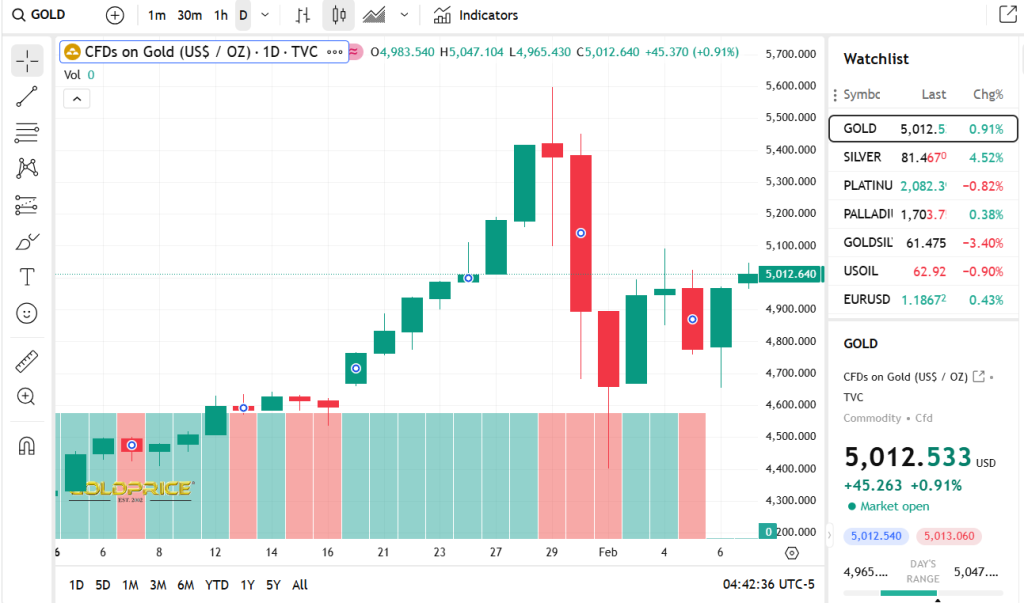
Silver’s recent path has been far more turbulent. After rising sharply through 2025 and into early 2026, silver plunged by large margins, erasing significant year‑to‑date gains. Retail investors continued to pour capital into silver ETFs despite this volatility, demonstrating strong speculative interest.
On India’s MCX, silver prices rebounded by roughly ₹10,000 per kg after substantial declines the previous week, while gold futures rose by about ₹3,000 per 10 grams. []
Are These Rebounds a Buying Opportunity?
What Analysts are Saying on Gold Prices?
Market analysts and commentators offer differing views. Some see the recent rebound in gold and silver as a short‑term bounce within a broader volatile ride. Others point to structural demand drivers, such as safe‑haven flows, persistent inflation concerns, and central bank buying, as justification for sustained strength in precious metals.
In silver markets, record inflows into exchange‑traded funds show strong retail conviction even as prices plunged, suggesting that some investors view the current price action as a buying opportunity rather than a breakdown.
What Should Traders Watch Next?
A key focus for traders now is incoming U.S. economic data, especially non‑farm payrolls and inflation prints, which could reset expectations for Fed policy moves and further volatility in metals prices.
In addition, geopolitical developments and broader risk sentiment, especially as global equities and currency markets shift, will continue to affect metals flows. Analytical tools, including advanced AI stock analysis tools and macro data models, are being used by some market participants to assess near‑term price direction amid this noise.
What Current Gold Price Means for Investors?
Gold as a Safe Haven?
Gold remains a principal hedge against uncertainty. Its recovery above $5,000 reflects both its historical role and the renewed investor interest after rapid sell‑offs. Traders often pivot to gold when equities wobble or inflation risks rise, and that role appears intact as of February 2026.
Silver’s Dual Role and Higher Volatility
Silver’s price action highlights its unique position as both a precious metal and an industrial commodity. Its stronger volatility compared with gold stems from lighter liquidity and heavier speculative flows, particularly from retail investors.
Is This the Start of a New Trend?
While rebounds are encouraging, the recent price swings underscore the importance of risk management and trend confirmation before committing capital. Long‑term investors may seek to position gradually, whereas short‑term traders should prepare for continuing choppiness.
Conclusion: What Comes Next in Metals Markets
The rebound in gold and silver prices after a whipsaw trading week shows that precious metals are not just reacting to headlines, they are reacting to global macro forces that are still unsettled in early February 2026. Strong recoveries signal renewed interest, but wide price swings remind investors that volatility remains elevated.
As markets prepare for upcoming economic data and policy decisions, gold and silver will continue to be focal points for traders looking to hedge risk or capture trend moves. Staying informed, including tracking price benchmarks, ETF flows, and sentiment indicators, will be key to navigating this dynamic phase in the metals mark
Advertisement
Frequently Asked Questions (FAQs)
Gold rose above $5,000 on February 9, 2026. Traders reacted to a softer U.S. dollar, Fed policy uncertainty, and safe-haven demand as markets faced high volatility this week.
Silver jumped near $80/oz on February 9, 2026. Retail buying, ETF inflows, and industrial demand pushed prices up after last week’s steep fall in volatile trading sessions.
Both metals have pros and risks. Gold is safer during uncertainty, while silver is more volatile. Investors should watch trends, policy updates, and economic data as of February 2026.
Disclaimer:
The content shared by Meyka AI PTY LTD is solely for research and informational purposes. Meyka is not a financial advisory service, and the information provided should not be considered investment or trading advice.
Advertisement
What brings you to Meyka?
Pick what interests you most and we will get you started.
I'm here to read news
Find more articles like this one
I'm here to research stocks
Ask our AI about any stock
I'm here to track my Portfolio
Get daily updates and alerts (coming March 2026)