Gold Prices Hold Near $5,000/oz on Geopolitical Risks; Fed Minutes Limit Gains
Gold prices are sitting on a knife‑edge near the $5,000 per ounce milestone as global markets navigate rising political tensions and fresh signals from U.S. policymakers. On February 18-19, 2026, bullion prices climbed above the $4,970-$4,990 range, briefly flirting with the five‑thousand mark amid intensifying safe‑haven demand.
Investors are watching geopolitical flashpoints from strained U.S.-Middle East relations to stalled peace talks in Europe, while also digesting the Federal Reserve’s latest meeting minutes, which revealed divisions over future interest rates. The tug‑of‑war between risk aversion and monetary policy expectations is keeping gold trade lively and unpredictable.
Advertisement
Let’s unpack what’s driving the metal’s recent strength and what comes next for traders and long‑term holders.
Gold Price at a Crossroads: Numbers, Levels & What They Mean
Gold has climbed far beyond historical norms. In 2025 and early 2026, prices surged sharply. By late January 2026, spot gold broke through key levels near $4,900 per ounce and briefly approached $5,000, driven by global risks and safe‑haven demand. As of mid‑February, futures and physical markets show gold trading in a tight range just below the psychological $5,000 mark as markets await catalysts from U.S. policy and geopolitical news.
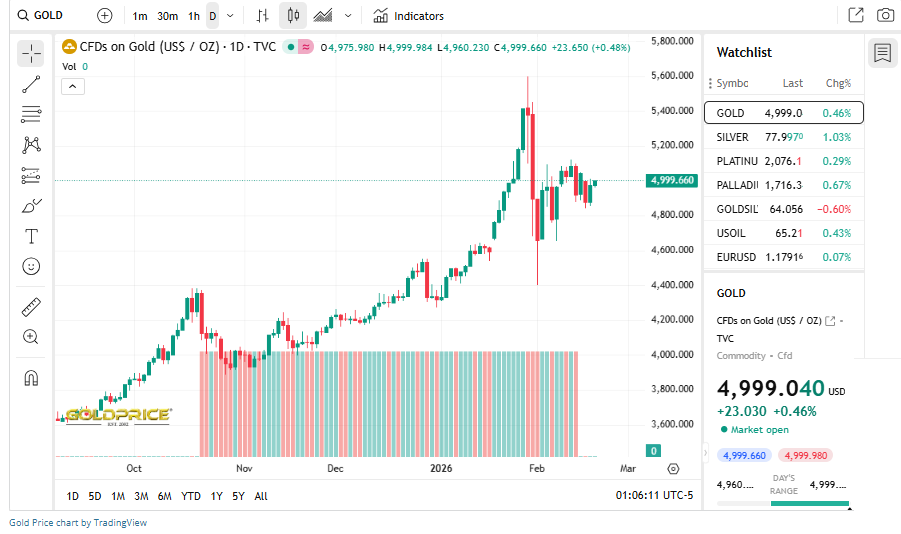
These levels matter. Traders view $5,000/oz as a major resistance point. Support zones have shifted higher as investors price in macro uncertainty. Smaller pullbacks have occurred around $4,850-$4,900, but bulls argue the overall trend remains intact.
In simple terms, gold is holding near record peaks. Short‑term traders watch technical ranges. Long‑term holders see a continued rally if geopolitical and policy risks persist.
Why Geopolitical Tensions are Driving Gold Demand?
How Do Global Conflicts Affect Gold Prices?
Gold is widely seen as a safe‑haven asset. When political risks rise, investors flee riskier assets like stocks and bonds. Recent tensions in the Middle East and Europe have kept this dynamic alive through 2026. Ongoing conflicts and diplomatic friction have pushed capital toward gold, supporting prices near historic highs.
Even hints of escalation, such as renewed U.S.-Iran or Russia-Ukraine instability, can stimulate buying. During heightened risk periods, gold attracts global fund flows and physical buying, especially from central banks in emerging markets.
Market participants reacted when recent diplomatic talks eased some tensions, briefly knocking prices back below $4,900. But analysts note this does not change the larger risk environment.
What are Other Risk Drivers Beyond War?
Several structural trends also elevate geopolitical risk pricing in gold:
- De‑dollarization efforts by some major economies increase demand for hard assets like gold.
- Trade policy unpredictability and tariff disputes affect global growth expectations.
- Debt and currency concerns make many investors wary of traditional financial assets.
These combined pressures keep a risk premium embedded in gold prices.
How the Fed Minutes and Monetary Policy Influence Metal Prices?
What Did the Fed Minutes Reveal?
Investors closely studied the Federal Reserve’s January 2026 meeting minutes for clues on interest rates and inflation outlook. The minutes showed a debate among policymakers about the future path of interest rates, with some members favoring continued tight policy to tame inflation. This lack of consensus has made markets cautious. Analysts say this mixed message limits strong upside for gold, as higher rates can reduce demand for non‑yielding assets like bullion.
The Fed’s stance still matters. If policymakers shift toward rate cuts later in 2026, gold could benefit as yield‑bearing assets become less attractive in comparison.
How Do the Dollar and Yields Impact Gold?
The price of gold often moves inversely to the U.S. dollar and Treasury yields. When the dollar strengthens, gold tends to soften, and vice versa. Recently, a stronger dollar has pressured gold prices slightly, highlighting the sensitivity of bullion to currency and rate expectations.
Higher yields raise the opportunity cost of owning gold. But if economic data weakens or risk aversion increases, downward pressure on yields and the dollar could support renewed gold strength.
What Analysts and Forecasts Say About Gold’s Path?
What are Bank Forecasts for Gold in 2026-2027?
Major financial institutions have revised gold price forecasts upward as risk factors persist:
- HSBC expects gold to hit around $5,000 per ounce in early 2026, supported by safe‑haven demand and debt concerns.
- UBS, Goldman Sachs, Deutsche Bank, and others have projected year‑end 2026 prices between $6,000 and $6,300 per ounce, showing strong institutional confidence in continued upside.
Many forecasts embed the idea that global uncertainty and shifts in asset allocations will sustain elevated gold levels through 2026 and beyond. An AI stock analysis tool that monitors macro trends also highlights how geopolitical risk premiums factor into commodity valuations, including gold.
What Do Long-Term Strategists See?
Some analysts argue that a structural bull market in gold will continue as global debt and inflation pressures persist. Models suggest that gold’s role as a hedge against currency debasement and systemic risk could sustain higher prices even if short‑term volatility remains.
Others caution that strong levels may attract profit‑taking or correction, especially if macro risks subside more quickly than expected.
Final Words
Gold hovers near $5,000/oz in early 2026 due to geopolitical risks and investor demand. Fed signals and a stronger dollar limit gains, while forecasts remain bullish for later in 2026.
Advertisement
Frequently Asked Questions (FAQs)
Gold touched near $5,000 in February 2026. Its future depends on global risks, inflation, and Fed actions. Prices may stay high, but could also pull back slightly.
Gold rises when investors want safety. Geopolitical tensions, inflation fears, and central bank buying push prices up. Economic uncertainty also makes people choose gold as a safe asset.
Federal Reserve policies influence interest rates. Higher rates can lower gold demand, while rate cuts can boost it. Fed minutes from February 2026 showed mixed signals for investors.
Disclaimer:
The content shared by Meyka AI PTY LTD is solely for research and informational purposes. Meyka is not a financial advisory service, and the information provided should not be considered investment or trading advice.
Advertisement
What brings you to Meyka?
Pick what interests you most and we will get you started.
I'm here to read news
Find more articles like this one
I'm here to research stocks
Ask our AI about any stock
I'm here to track my Portfolio
Get daily updates and alerts (coming March 2026)