FTSE 100 performance remains central to global equity sentiment in February 2026.
London equities weakened while broader European markets traded unevenly after mixed earnings and macro signals.
Recent data shows the FTSE 100 opened near 10,36 with a 1-month gain of 2.58%.
This shift follows record highs earlier in February and renewed geopolitical and policy uncertainty.
For investors, today’s FTSE 100 movement reflects rotation, earnings digestion, and global macro positioning rather than structural weakness.
Advertisement
FTSE 100 Pullback After Record Momentum
Record highs set the backdrop
FTSE 100 recently reached a record closing level of 10,402.34 on 4 February 2026, marking historic strength. However, short-term declines emerged as banking and healthcare stocks weakened and investors rotated toward U.S. technology. This shows the index remains sensitive to global capital flows despite strong long-term gains.
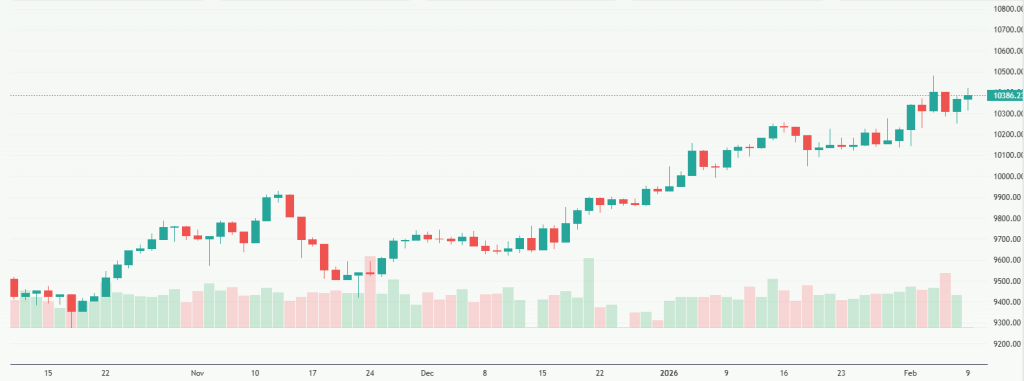
Current decline reflects rotation, not collapse
Global markets still show resilience, with Japan’s Nikkei surging and U.S. futures stabilizing.
Meanwhile, the FTSE 100 slipped about 0.5% alongside mixed European performance.
For investors, this indicates consolidation after record highs rather than a reversal of trend.
European Stocks Mixed as Earnings Drive Direction
Corporate updates shape sentiment
European equities stayed flat as investors assessed uneven earnings across sectors. Energy shares declined while luxury companies posted gains, highlighting sector divergence.
This pattern explains why FTSE 100 direction diverges from continental peers during earnings season.
Macro and political signals add pressure
UK assets weakened as political uncertainty weighed on sentiment and borrowing costs shifted. At the same time, investors await U.S. inflation and labor data to guide rate expectations.
Looking ahead, macro data may dominate FTSE 100 volatility more than company fundamentals.
Structural Strength Still Supports FTSE 100
Long-term performance remains intact
Despite short-term dips, FTSE 100 maintains strong yearly momentum above 19% growth.
European benchmarks also cover broad regional capitalization, supporting diversification flows.
This shows institutional allocation toward Europe has not reversed.
Global volatility explains near-term swings
January’s U.S. market sell-off triggered worldwide volatility across major indices.
Such shocks often create temporary pullbacks even within bullish cycles.
For investors, FTSE 100 weakness should be evaluated within this global volatility framework.
Recent Updates Affecting FTSE 100 (February 2026)
- European shares opened mixed as investors awaited earnings and U.S. economic data.
- FTSE 100 slipped roughly 0.5% while France rose and Germany edged lower.
- UK political uncertainty pressured stocks, bonds, and the pound simultaneously.
- Energy sector weakness and luxury strength created sector divergence across Europe.
- The index still holds strong yearly gains above 19% despite volatility.
- Record highs earlier in February confirm persistent institutional demand.
These updates show FTSE 100 direction depends on macro data, sector rotation, and earnings momentum rather than a single catalyst.
Market Sentiment Around FTSE 100
Social and media signals indicate cautious optimism. Global equities rising in Japan and stabilizing in the U.S. offset European hesitation. Political risk in the UK tempers bullish positioning despite strong historical performance. Overall sentiment suggests consolidation within a broader upward cycle rather than bearish reversal.
Conclusion
FTSE 100 weakness in February 2026 reflects rotation, earnings digestion, and macro uncertainty. Record highs, strong yearly growth, and resilient global equities still support the long-term outlook. Short-term volatility remains tied to policy signals, political developments, and sector divergence. For investors, disciplined positioning and macro awareness remain essential.
The broader trend still favors stability unless global growth expectations deteriorate materially.
Advertisement
Frequently Asked Questions (FAQs)
FTSE 100 recently traded near 10,369 with strong yearly gains above 19%, confirming long-term strength despite daily volatility.
The decline reflects sector rotation, political uncertainty in the UK, and mixed European earnings rather than structural weakness.
Yes. The index reached a record close above 10,402 in early February 2026, indicating sustained bullish momentum.
Movements in U.S. technology stocks, Japanese rallies, and macro data expectations directly shape FTSE 100 sentiment.
Disclaimer:
The content shared by Meyka AI PTY LTD is solely for research and informational purposes. Meyka is not a financial advisory service, and the information provided should not be considered investment or trading advice.
Advertisement
What brings you to Meyka?
Pick what interests you most and we will get you started.
I'm here to read news
Find more articles like this one
I'm here to research stocks
Ask our AI about any stock
I'm here to track my Portfolio
Get daily updates and alerts (coming March 2026)