











BYD Signals Exports Likely to Surpass Previous Target by 15% This Year
China’s electric vehicle giant BYD is accelerating its global push in 2026 as overseas demand continues to rise. The company now expects its vehicle exports to exceed earlier forecasts by nearly 15% this year, signaling a major shift beyond its home market. This comes after a challenging 2025, when slowing domestic demand and rising competition pressured profits.
As of March 2026, analysts say international markets are becoming a key growth driver for BYD’s future. From Europe to emerging economies, its affordable EVs are gaining traction fast. So, what’s behind this export surge, and how could it reshape the global electric vehicle race?
BYD’s Export Growth Forecast – What Changed in 2026?
What is BYD’s new export target for 2026?
BYD has raised its 2026 export outlook after strong global demand. The company now expects exports to reach nearly 1.5 million vehicles, up from an earlier target of about 1.3 million units. This reflects an increase of roughly 15%.
The revised forecast shows confidence in overseas markets. It also signals a shift in strategy. BYD is no longer relying mainly on China. Instead, it is building a strong global sales base.
How strong is BYD’s export momentum?
Export growth has been steady since 2025. Key highlights include:
- Overseas shipments crossed 1 million units in 2025
- Export share rose to nearly 20% of total sales
- Monthly export volumes stayed strong despite weak domestic demand
This trend shows that global markets are becoming a core revenue driver for BYD.
Why BYD Is Pivoting to Global Markets?
Why is domestic demand slowing in China?
China’s EV market is still large, but growth is slowing. Several factors are driving this:
- Price competition has intensified among local brands
- Entry-level EV demand is weakening
- Government subsidies have reduced
In 2025, BYD reported a profit decline of around 19%, its first drop in four years. This pushed the company to rethink its growth strategy.
How is competition affecting BYD?
Competition inside China is fierce. Many EV makers are cutting prices to gain market share. This has reduced profit margins across the industry. For BYD:
- Price wars are hurting profitability
- New entrants are increasing pressure
- Premium positioning is still developing
This makes global expansion more attractive.
Why are exports more profitable?
Overseas markets offer better pricing power. Buyers in Europe and other regions are willing to pay more for EVs. Key advantages:
- Higher margins compared to China
- Less intense price competition
- Strong demand for affordable EVs
Exports are now seen as a long-term growth engine.
Key Markets Driving BYD’s Export Boom
How is BYD expanding in Europe?
Europe is a top priority market. BYD is scaling fast:
- Plans to reach 2,000 sales points by 2026
- Investing in local manufacturing in countries like Hungary
- Expanding dealership networks rapidly
European demand for budget-friendly EVs is rising. BYD is well-positioned to capture this segment.
Which emerging markets are fueling growth?
BYD is also growing fast in developing regions:
- Southeast Asia (Thailand, Indonesia)
- Latin America (Brazil, Mexico)
- Africa (South Africa expansion plans)
These markets offer:
- Less competition
- Growing middle-class demand
- Government support for EV adoption
Is BYD reducing reliance on China?
Yes. BYD is building a balanced global portfolio:
- Europe, ASEAN, and Latin America are key growth pillars
- Export share is rising every year
- Domestic dependency is gradually decreasing
This diversification lowers risk and improves long-term stability.
Technology and Innovation Supporting Export Growth
What role does battery innovation play?
BYD’s Blade Battery is a major advantage. It offers:
- High safety standards
- Longer lifespan
- Lower cost compared to competitors
Battery innovation helps BYD stay competitive globally.
How is fast-charging technology evolving?
BYD is improving charging speed significantly:
- New systems can charge from 10% to 70% in minutes
- Focus on reducing range anxiety
Fast charging is critical for global adoption.
What gives BYD a competitive edge?
BYD benefits from vertical integration:
- Produces its own batteries
- Controls supply chain
- Reduces production costs
This allows competitive pricing while maintaining margins.
Challenges That Could Impact BYD’s Export Targets
What geopolitical risks does BYD face?
Global expansion is not risk-free. Key challenges include:
- Tariffs in the US and Europe
- Trade restrictions on Chinese EVs
- Regulatory compliance requirements
These factors could slow expansion.
Are profitability concerns still relevant?
Yes. Export growth requires heavy investment:
- Building factories overseas
- Expanding dealership networks
- Marketing and brand building
Short-term margins may remain under pressure.
Is infrastructure a limiting factor?
Charging infrastructure is still weak in many regions:
- Emerging markets lack charging networks
- High reliance on government support
- Slow infrastructure rollout
This can impact EV adoption rates.
What This Means for the Global EV Market?
Is BYD challenging global leaders?
BYD has become a serious competitor to global EV giants. It was among the top EV sellers globally in 2025 by volume. Its export push will:
- Increase global competition
- Pressure pricing across markets
- Challenge established brands
Are affordable EVs becoming the new trend?
Yes. BYD is leading the affordable EV segment:
- Lower-cost vehicles attract mass buyers
- Expanding middle-class demand globally
- Strong value-for-money positioning
This trend could reshape the EV market.
Will EV adoption accelerate globally?
Several factors support faster adoption:
- Rising fuel prices
- Climate policies
- Better EV technology
BYD’s expansion could speed up this transition.
The BYD Stock Analysis and Forecast
BYD stock overview
BYD Company Limited is listed in Hong Kong and Shenzhen. It remains a key EV stock in Asia.
- Strong revenue growth driven by EV sales
- Increasing global presence
- Short-term margin pressure due to expansion
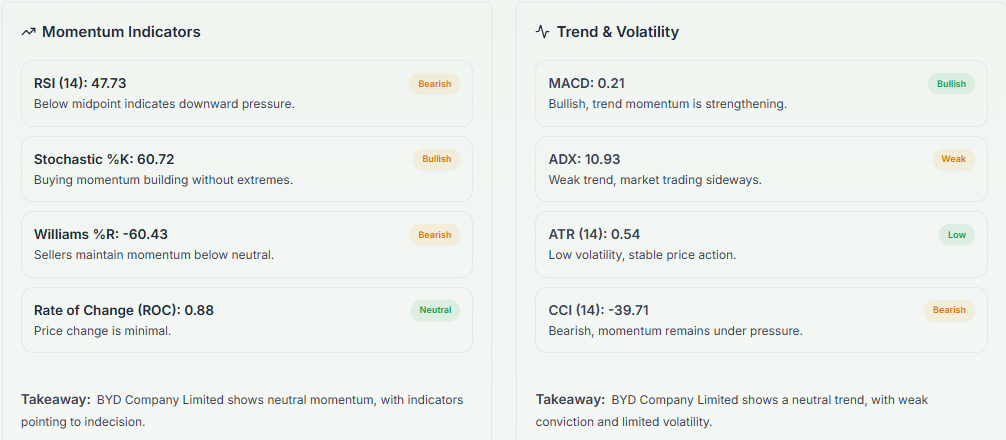
Technical analysis summary
Recent trends show:
- Consolidation after rapid growth
- Support levels holding steady
- Moderate bullish outlook if export growth continues
What Meyka says?
According to insights often tracked on Meyka-style AI platforms:
- Export growth is a key bullish signal
- Global diversification reduces long-term risk
- Profit margins remain a watch point
AI stock analysis tools highlight BYD’s strong fundamentals but caution about short-term volatility.
What other analysts are saying?
- Many analysts see BYD as a long-term growth story
- Export expansion is viewed as a positive catalyst
- Risks include global regulations and competition
Overall sentiment remains cautiously optimistic.
Wrap Up
BYD’s plan to exceed its export target by 15% reflects a clear shift toward global growth. Weak domestic demand has accelerated this move. Strong overseas demand, cost advantages, and innovation are driving results. However, risks like trade barriers and margin pressure remain. If BYD executes well, it can strengthen its global leadership and reshape the EV market in the coming years.
Frequently Asked Questions (FAQs)
Yes, as of March 2026, BYD expects exports to reach around 1.5 million vehicles, about 15% higher than earlier estimates.
BYD is expanding globally due to slowing China demand, rising competition, and better profit margins in overseas markets as of 2026.
As of 2026, Europe, Brazil, Thailand, and South Africa are key markets driving BYD’s electric vehicle export growth globally.
Disclaimer:
The content shared by Meyka AI PTY LTD is solely for research and informational purposes. Meyka is not a financial advisory service, and the information provided should not be considered investment or trading advice.
What brings you to Meyka?
Pick what interests you most and we will get you started.
I'm here to read news
Find more articles like this one
I'm here to research stocks
Ask our AI about any stock
I'm here to track my Portfolio
Get daily updates and alerts (coming March 2026)