











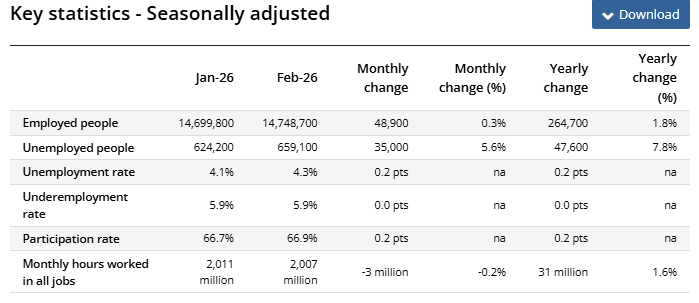
Australia’s jobs data for February 2026 delivered a surprise that has economists and everyday workers talking. New figures show the unemployment rate climbed to 4.3%, rising from 4.1% in January, even as more people entered the workforce and total jobs grew.
What makes this twist striking is that the gain came mainly from part‑time roles, while full‑time employment declined, hinting at deeper shifts in job quality and stability. At a time when inflation and living costs are high, this mixed jobs picture raises real questions about job security, wage growth, and what lies ahead for Australia’s labour market.
What the Latest Data Shows: Key Stats & Dates
Unemployment Rate Climbs to 4.3% in February 2026
Australia’s labour market delivered a surprise in February 2026 when the seasonally adjusted unemployment rate rose to 4.3%, up from 4.1% in January, and above the expected 4.1% forecast. Official data from the Australian Bureau of Statistics (ABS) showed this increase reflects an additional about 35,000 unemployed people, marking the highest level in three months.
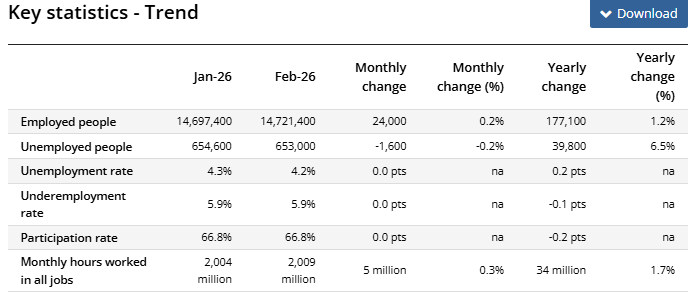
The trend unemployment rate, a smoother indicator, was slightly lower at 4.2%, highlighting mixed signals in the labour market.
Job Growth Numbers: Part‑Time Up, Full‑Time Down
Total employment rose by 48,900 jobs in February 2026, significantly beating expectations of around 20,000 and January’s revised 26,100 gain.
However, this headline employment growth masked a fall in full‑time jobs:
- Full‑time jobs fell by about 30,500.
- Part‑time employment grew by approximately 79,400.
This divergence suggests that while more people found work, the quality and stability of many of those jobs were weaker, with a shift toward part‑time roles.
Participation and Hours Worked
The labour force participation rate, the share of working‑age people either employed or seeking work, lifted to 66.9% in February. At the same time, total hours worked declined by 0.2%, signaling that workers are not fully utilised compared with levels earlier in 2026.
Underlying Drivers of the Jobless Rate Rise
Why Did the Unemployment Rate Increase Despite Job Growth?
One reason the unemployment rate rose while employment grew is the mix of job types added. The strong increase in part‑time jobs, particularly among older workers, helped swell total employment figures. In contrast, the drop in full‑time roles weakened the labour market’s core strength.
Economists also note that more Australians entered or re‑entered the labour market, raising the participation rate and putting upward pressure on the jobless rate, even with net job additions. Fewer unemployed people transitioning into work compared to previous Februarys also contributed to the rise.
What Is Behind the Decline in Full‑Time Work?
The fall in full‑time employment points to labour demand softening at standard work hours. Employers may be hiring more part‑time or flexible workers as a way to remain cost‑effective amid economic uncertainty, inflation pressures, and higher borrowing costs. Analysts also point to broader trends in gig and casual work that have gained traction since the pandemic.
Does Migration Affect the Jobless Rate?
Recent ABS releases and community discussions highlight a surge in net migration, adding large numbers of working‑age people to the labour force in early 2026. This influx increases both employment and the jobless base, which can nudge up the unemployment rate unless job growth keeps pace.
What Economists & Markets are Saying?
How Is the RBA Responding?
The Reserve Bank of Australia (RBA) has maintained a clearly hawkish stance on monetary policy amid persistent inflation. In March 2026, the RBA raised the cash rate to 4.1%, reversing earlier cuts and signaling that it prioritises inflation control, even in the face of a tightening labour market.
RBA Governor Michele Bullock stated that inflation remained too high, even before recent fuel price rises from geopolitical tensions. The bank is prepared to adjust further if needed, though it insists it does not seek to force a recession.
Market economists see the mixed labour force data as unlikely to derail the tightening bias of the RBA. Some forecasts now price in another rate hike in May 2026 and possibly more through the year if inflation persists alongside tight labour conditions.
Are Labour Market Conditions Weakening or Just Noisy?
Many analysts argue that the February report contains noisy signals rather than clear weakness. Some of this is statistical noise, where seasonal adjustments and swings in part‑time roles obscure underlying trends. Others point out that hours worked and full‑time job metrics show early signs of softening that deserve close attention.
Historical & Trend Context
How Does This Compare to Previous Months?
Earlier in 2026, Australia’s job market appeared stronger. In January 2026, the unemployment rate fell to 4.1%, and job growth leaned heavily on full‑time roles with improved participation and hours worked.
The sudden shift to more part‑time jobs and fewer full‑time roles highlights how rapidly labour dynamics can change in response to economic and policy influences.
Longer‑Term Trends in Australian Labour
Across 2025, the unemployment rate generally stayed low but began to show a minor upward drift into late 2025, with jobs slowing and job ads declining. Independent research from ANZ noted a fall in job advertisements through late 2025, signalling softer hiring trends even before the February 2026 data.
OECD projections going into 2026 expected the Australian unemployment rate could trend toward 4.3% by the end of the year, as labour market tightness eases and population growth remains strong.
Local & Global Economic Overlaps
How Do Global Factors Factor In?
International price shocks, including energy prices rising due to geopolitical tensions, have pushed inflation upward in Australia. Higher consumer costs, mortgage payments, and living expenses have cut into household budgets, even as advertised wages showed growth.
This global inflation backdrop influences business confidence and hiring decisions. Employers facing higher input costs may hire more part‑time workers instead of offering full‑time contracts. This pattern surfaced in the February data and influenced broader labour market trends.
Final Words
Australia’s labour market in February 2026 delivered mixed signals. The unemployment rate rising to 4.3%, paired with a shift away from full‑time jobs, suggests deeper adjustments beneath headline job growth.
While total employment expanded, the quality of that growth and broader economic pressures will shape future hiring. With inflation still elevated and monetary policy tightening, the coming months will be critical for workers, businesses, and policymakers alike.
Frequently Asked Questions (FAQs)
Australia’s jobless rate rose to 4.3% on March 19, 2026, as full-time jobs fell and more people joined the workforce.
Although total jobs grew in February 2026, full-time employment fell, showing early signs of softening in the labour market.
The RBA may adjust rates cautiously, but in March 2026, it will continue monitoring inflation and employment before making changes.
Disclaimer:
The content shared by Meyka AI PTY LTD is solely for research and informational purposes. Meyka is not a financial advisory service, and the information provided should not be considered investment or trading advice.
What brings you to Meyka?
Pick what interests you most and we will get you started.
I'm here to read news
Find more articles like this one
I'm here to research stocks
Ask our AI about any stock
I'm here to track my Portfolio
Get daily updates and alerts (coming March 2026)