











ASX200 sinks as Middle East war fears trigger sharp selloff in Australian share market
The Australian share market took a sharp turn this week as the ASX200 index slid sharply on March 3-4, 2026, driven by growing Middle East war fears and rising global risk aversion. Markets reacted nervously to escalating conflict in the Gulf, with oil prices spiking and investors shifting out of riskier assets. On Tuesday, the S&P/ASX 200 dipped more than 1.3 per cent, marking its weakest session in over two weeks as broad sell‑offs hit nearly every sector.
This sudden drop didn’t just affect Australian equities; global markets also reeled on inflation worries and supply‑chain disruption fears. In this article, we unpack what happened, why it matters, and what it could mean for investors going forward.
ASX Market Reaction to Middle East Conflict
How much did the ASX 200 fall?
The Australian share market slid sharply as global markets reacted to an escalating conflict in the Middle East. On March 3-4, 2026, the benchmark S&P/ASX 200 dropped more than 1.3-1.7 per cent in early trading, driven by fear and risk‑off flows.
Key figures include:
- ASX 200 closed around 9,076.6, down 124.3 points or 1.35 per cent on March 3.
- Early Wednesday trade saw the index slip to below 8,920, extending losses.
- News reports value the total market wipe‑out at over $60 billion AUD due to the sell‑off.
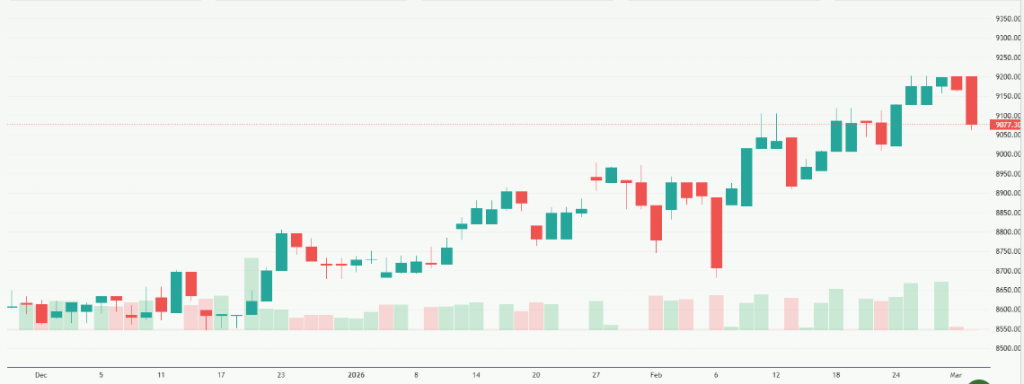
Almost every sector was weaker, with materials and financial stocks leading the declines.
What Triggered the Sell‑Off?
Why did Middle East war fears hit markets?
Investors fear that the conflict, particularly involving the US, Israel, and Iran, could disrupt global energy supplies and push inflation higher.
Key triggers:
- Surging oil prices to the highest levels in many months.
- A sharp rise in geopolitical risk is prompting “risk‑off” trading.
- Expectations that central banks may delay rate cuts or even tighten policy amid inflation risk.
Analysts said the sell‑off was also fueled by broader global market weakness and concerns around higher costs for consumers and businesses.
Sector Performance and Stock Movers
Which sectors were hit hardest?
Several sectors of the ASX200 suffered:
- Materials: One of the weakest, driven by falls in mining stocks.
- Financials and Industrials: Broad weakness as risk appetite waned.
- Consumer and property: Downbeat as confidence slipped.
Only a few areas held up better, such as technology stocks that bucked the broader trend on March 4.
Notable stock moves
- Gold miners like Northern Star and Evolution Mining fell over 6 per cent in early trading.
- Mining giants BHP and Rio Tinto were also weaker as sentiment shifted away from cyclical risk.
Energy stocks were mixed; some gained on higher crude prices, but broader equity selling limited overall performance.
Global Market Context
Did other markets fall too?
Yes. The ASX sell‑off came with global pressure:
- Asian markets slumped sharply, with South Korea’s Kospi down over 10 per cent at one point.
- European shares also hit two‑week lows amid rising geopolitical risk.
- Wall Street was softer, with major US indices pulling back.
Many global markets echoed the risk‑off mood as investors shifted toward safer assets like bonds and some commodities.
How are oil and gold affecting markets now?
Oil prices climbed sharply due to fears of supply disruption through the Strait of Hormuz, a key transit corridor for crude shipments.
Gold, often a haven asset, also saw strength, though some gold miners lagged as broader sell‑offs hit equity markets.
Inflation, Monetary Policy and the RBA
Could central banks react to this sell‑off?
Investors are watching central bank signals closely. The Reserve Bank of Australia (RBA) has indicated that inflation remains a concern.
Some economists say the Middle East conflict could delay expected rate cuts or even keep tight policy in place if inflation expectations rise. This concern has contributed to the risk‑off stance seen in markets.
What Meyka Says on the ASX200 – Stock Insights Spotlight
Current Index Details
- Ticker: ^AXJO
- Current Price (March 4, 2026): 9,072.6 AUD
- Daily Change: -126.0 points (-1.37%)
- Day Range: 9,060 – 9,200 AUD
- 50-Day Average: 8,860 AUD | 200-Day Average: 8,760 AUD
- Year-to-Date Change: +5.42%
- 1-Year Change: +11.58%
Technical Analysis Summary
- The short-term trend shows negative momentum due to recent sell-offs.
- Support levels near 8,860-8,760 AUD are key; a breach may trigger further downside.
- Resistance at 9,200 AUD, with potential upside limited until geopolitical concerns ease.
- AI-powered analysis from Meyka indicates heightened volatility and recommends monitoring risk closely.
What Meyka Says
Meyka highlights that Middle East tensions and rising oil prices are driving market sentiment. Investors are moving cautiously, and defensive sectors may outperform in the short term.
Supporting Insights from Other Analysts
- Analysts note that materials and financials are most affected.
- Global market trends and central bank policies may amplify ASX 200 volatility.
- AI tools and Meyka forecasts both suggest risk-off strategies until geopolitical clarity improves.
Investor Outlook: What Comes Next for ^AXJO
What should investors watch?
Investors should monitor:
- Oil price trends – any further spikes will add inflation pressure.
- Central bank guidance – especially from the RBA and US Federal Reserve.
- Earnings updates and economic data – key domestic figures like GDP and jobs.
- Conflict developments in the Middle East – duration and intensity matter.
Short‑term volatility is likely to remain elevated as markets absorb evolving news. Analysts recommend focusing on risk management and diversification during uncertain periods.
Final Words
The ASX 200’s sharp drop highlights how quickly global conflicts can ripple through markets. Investors face heightened volatility from Middle East tensions, rising oil prices, and inflation worries. Staying informed, watching central bank moves, and managing risk are crucial as uncertainty continues.
Frequently Asked Questions (FAQs)
The ASX 200 fell by over 1.3% on March 3-4, 2026. Investors sold shares due to fears of Middle East war, rising oil prices, and possible inflation, causing broad market weakness.
Middle East tensions raise oil prices and global risk. Higher costs and uncertainty make investors sell shares. This pushes the ASX lower and increases market volatility. (March 2026)
On March 3-4, 2026, materials and financials were hardest hit. Mining and banks lost value as investors moved to safer assets. Energy and tech had mixed performance.
Disclaimer:
The content shared by Meyka AI PTY LTD is solely for research and informational purposes. Meyka is not a financial advisory service, and the information provided should not be considered investment or trading advice.
What brings you to Meyka?
Pick what interests you most and we will get you started.
I'm here to read news
Find more articles like this one
I'm here to research stocks
Ask our AI about any stock
I'm here to track my Portfolio
Get daily updates and alerts (coming March 2026)