











Asian markets opened sharply lower on March 30, 2026, as rising geopolitical tensions rattled global investors. Japan’s Nikkei 225 dropped nearly 5%, while South Korea’s Kospi also slid by a similar margin.
The sell-off comes as the US-Iran tensions intensify, pushing oil prices above $115 per barrel and raising inflation fears worldwide. Investors are quickly moving to safer assets, signaling a classic risk-off mood. This sudden market reaction shows how closely Asia is tied to global events. So, what is driving this sharp decline, and what could happen next?
Why are Asian markets falling today?
What is driving the sudden market crash?
Asian markets are falling due to rising geopolitical risk and energy shocks. The main trigger is the escalating US-Iran tensions. The conflict has now entered its fifth week as of March 30, 2026. This has increased uncertainty across global markets. Investors are reacting quickly:
- Selling equities to reduce risk
- Moving funds into safe assets like gold and US dollars
- Avoiding sectors sensitive to oil prices
This panic selling is pushing indices lower across Asia.
How does the Strait of Hormuz disruption affect markets?
The Strait of Hormuz is one of the most critical oil routes in the world. Around 20% of the global oil supply passes through it. Current disruptions have:
- Slowed oil shipments
- Increased shipping costs
- Created supply fears
This has directly impacted oil-importing countries like Japan and South Korea.
Why are rising oil prices a big concern?
Oil prices have crossed $115 per barrel in March 2026, up sharply from earlier levels. Higher oil prices lead to:
- Rising inflation
- Increased production costs
- Lower corporate profits
This creates pressure on stock markets and slows economic growth.
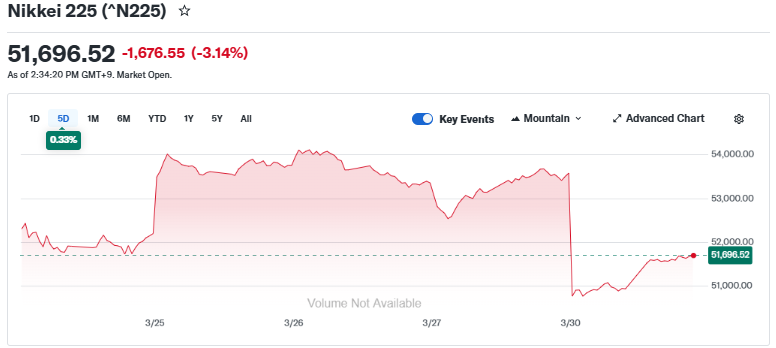
Nikkei 225 Performance Today
How much has the Nikkei 225 fallen?
The Nikkei 225 dropped nearly 4-5% in early trading on March 30, 2026. It lost over 2,400 points, marking one of its sharpest recent declines.
Why is Japan’s market hit harder?
Japan depends heavily on imported energy. This makes it more vulnerable to oil price shocks. Key reasons:
- High energy import costs
- Strong global trade exposure
- Weak investor sentiment in export stocks
Technology and manufacturing stocks led the decline.
Is this a long-term concern?
Not necessarily. The Nikkei had recently touched record highs above 58,000 in February 2026. This suggests strong fundamentals. The current fall is driven by external shocks, not internal weakness.
Kospi and Other Asian Markets Reaction
How did the Kospi perform today?
The Kospi fell between 3% and 5% on March 30, 2026. Tech-heavy stocks saw the biggest losses. Small-cap stocks also dropped sharply.
What is happening across other Asian markets?
The decline is not limited to Japan and South Korea. Other markets:
- Hong Kong’s Hang Seng fell around 1.5-2%
- China’s Shanghai Composite slipped about 0.5-1%
- Australia’s ASX 200 dropped over 1%
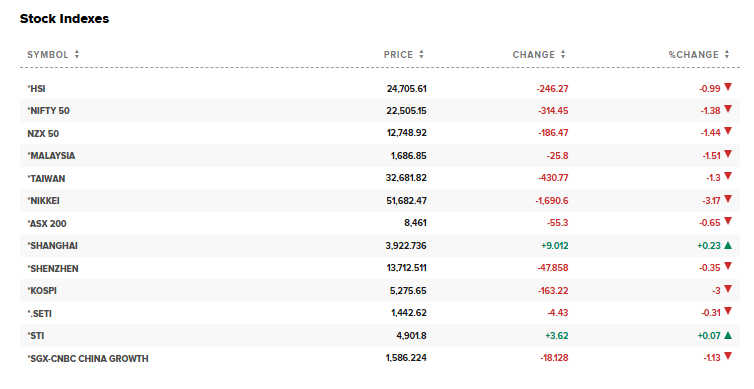
This shows a region-wide risk-off sentiment.
How are investors reacting?
Investors are becoming cautious:
- Moving money into bonds
- Holding cash positions
- Reducing exposure to volatile sectors
This behavior is typical during global uncertainty.
Global Ripple Effects on Financial Markets
Did Wall Street influence Asian markets?
Yes. US markets ended the previous week in losses. Key points:
Asian markets often follow US trends, especially during crises.
Are inflation fears rising globally?
Yes. Rising oil prices are increasing global inflation concerns. Effects include:
- Higher transport and production costs
- Pressure on central banks
- Delay in interest rate cuts
This creates uncertainty for investors.
What is happening with currencies and bonds?
- The US dollar is strengthening due to safe-haven demand
- Bond yields are rising
- Emerging market currencies are weakening
These trends show tightening financial conditions worldwide.
Asian Stock Market: Key Sectors Hit the Hardest
Which sectors are under pressure?
Technology Sector
- High global exposure
- Sensitive to demand changes
Airlines and Logistics
- Fuel costs are rising sharply
- Profit margins shrinking
Manufacturing and Exports
- Supply chain disruptions
- Reduced global demand
These sectors are directly linked to oil and global trade.
What Investors Should Watch Next for Asian Stocks?
Will oil prices continue rising?
Oil prices are the biggest trigger right now. A move above $120 per barrel could increase market volatility further.
Can geopolitical tensions ease soon?
Any sign of a ceasefire or negotiation in the US-Iran conflict can stabilize markets. Escalation will do the opposite.
What role will central banks play?
Central banks may:
- Delay rate cuts
- Focus on controlling inflation
This will impact liquidity and stock performance.
Which economic data matters now?
Investors should track:
- Inflation reports
- GDP growth data
- Employment numbers
These indicators will guide future market direction.
Expert Insights & Asian Market Outlook
What are analysts saying?
Market experts expect continued volatility in the short term. Many believe the sell-off is driven by fear, not fundamentals.
What does Meyka say about Nikkei 225?
Short Stock Details / Forecast
- Trend: Bearish short-term
- Support level: Around 52,000
- Resistance level: Near 56,000
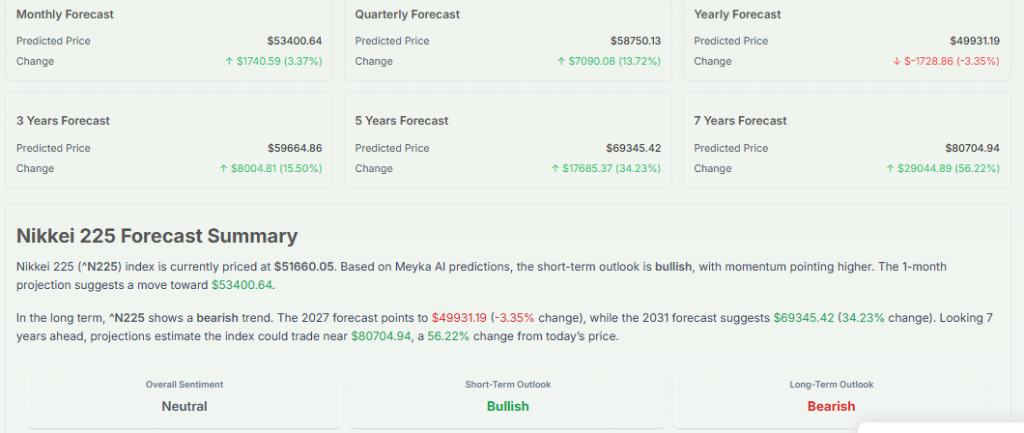
Technical Analysis Summary
- RSI indicates oversold conditions
- Moving averages show downward pressure
- Volatility index rising
What Meyka Says?
Meyka suggests caution. It highlights short-term downside risk but sees recovery potential if geopolitical tensions ease. The platform also uses an AI stock analysis tool to track real-time sentiment and price patterns.
What do other analysts suggest?
- Goldman Sachs: Short-term correction expected
- Morgan Stanley: Asia fundamentals remain strong
- JP Morgan: Oil prices are the key risk factor
Most analysts agree that long-term growth in Asia remains intact.
Wrap Up
Asian markets are facing strong pressure due to rising geopolitical tensions and surging oil prices. The sharp fall in the Nikkei 225 and the Kospi reflects global uncertainty and investor fear. However, fundamentals remain stable in the long term.
Market direction now depends on oil trends and geopolitical developments. Investors should stay cautious, track key signals, and avoid panic-driven decisions in this volatile phase.
Frequently Asked Questions (FAQs)
Asian markets are falling on March 30, 2026, due to rising oil prices, geopolitical tensions, and increased investor uncertainty globally.
The US-Iran conflict raises oil prices, disrupts trade routes, and increases uncertainty, causing investors to sell stocks and shift to safer assets.
The Nikkei 225 and Kospi may recover if tensions ease and oil prices stabilize in the coming weeks of 2026.
Disclaimer:
The content shared by Meyka AI PTY LTD is solely for research and informational purposes. Meyka is not a financial advisory service, and the information provided should not be considered investment or trading advice.
What brings you to Meyka?
Pick what interests you most and we will get you started.
I'm here to read news
Find more articles like this one
I'm here to research stocks
Ask our AI about any stock
I'm here to track my Portfolio
Get daily updates and alerts (coming March 2026)