On February 9, 2026, Asian markets opened with a bang as stock indices across the region climbed sharply. At the centre of the rally was Japan’s benchmark Nikkei 225, which surged past 57,000 points for the first time ever. This stunning move came after Prime Minister Sanae Takaichi’s decisive election win on February 8, giving her ruling coalition a strong majority and boosting investor confidence.
Investors reacted quickly to the political clarity, buying Japanese shares and lifting markets from Seoul to Sydney. The Nikkei’s record‑breaking jump set the tone for a broader Asia stocks rally, reflecting renewed risk appetite and optimism about economic policy ahead.
Advertisement
What Happened: The Takaichi Effect
How did Japan’s election win spark the market rally?
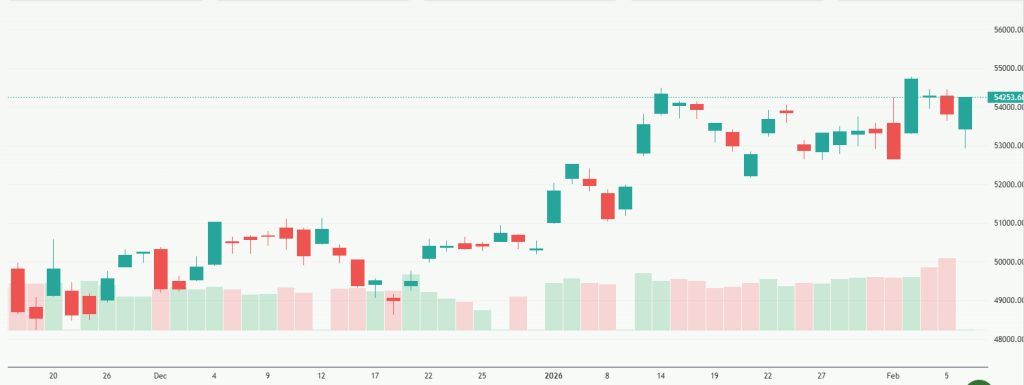
Japan’s stock market surged on February 9, 2026 after Prime Minister Sanae Takaichi’s Liberal Democratic Party (LDP) secured a supermajority in the lower house of parliament. Investors interpreted this strong political mandate as a signal that policy direction would be stable and pro‑growth, removing near‑term uncertainty that had weighed on markets. As a result, the Nikkei 225 jumped more than 5%, clearing above 57,000 points, a fresh record high.
This move was part of a broader “Takaichi trade” narrative, where markets priced in expectations of bold fiscal policy, tax incentives, and measures supporting corporate investment and wages. Analysts noted that clear policy direction tends to attract both domestic and foreign capital, boosting demand for equities.
What role did U.S. markets play?
Asia stocks, including Japan’s, also took a cue from Wall Street’s rebound in the previous session. A strong finish by U.S. tech stocks on Friday before the rally improved global investor risk appetite, encouraging inflows into Asian equities. This linkage highlights how global market sentiment can amplify regional political catalysts like the Takaichi election result.
Asian Stock Market: Regional Market Momentum
Which Asian markets moved higher?
The stock rally in Japan spilled over into other major Asian markets on February 9, 2026:
- South Korea’s KOSPI climbed about 4.3-4.36%, gaining momentum as investors took on risk.
- Australia’s S&P/ASX 200 rose roughly 1.9–1.93%.
- The Hang Seng Index (Hong Kong) was up ~1.8%, and China’s Shanghai Composite gained about 1.2-1.3%.
- Singapore’s Straits Times Index also saw modest gains.
These moves show that strong performance in Japan can help lift confidence in the region‑wide, especially when sentiment is already buoyed by global cues.
Did markets outside equities react too?
Yields on long‑term Japanese government bonds initially spiked but steadied as markets balanced optimism about stimulus with fiscal responsibility expectations. The Japanese yen fluctuated, briefly weakening then strengthening slightly as authorities voiced support to curb excess volatility.
Key Drivers Behind the Asian Stock Market Rally
Why did political clarity boost stocks?
Political stability is a major driver of equity markets because it reduces uncertainty. Before the election, traders were unsure how policy might change. With Takaichi’s clear majority, market participants now expect smoother decision‑making and fewer surprises in economic policy. This certainty boosts confidence among institutional and retail investors.
Which sectors led the gains?
Market breadth was strong, with almost all Nikkei components advancing. Traders highlighted gains in:
- Tech and AI‑related stocks
- Industrial and export‑oriented names
- Defensive sectors riding stimulus expectations
This broad‑based pickup suggests the rally wasn’t limited to one sector but reflected overall confidence in Japan’s economic direction.
Nikkei 225: Data, Forecast & Technical Summary
What is the Nikkei 225 doing now?
According to live price feeds and technical data, the Nikkei 225 (N225) has ranged dramatically over the past year. Recent measures show a 52‑week high above 57,757 and a technical “Strong Buy” signal based on moving averages and momentum indicators.
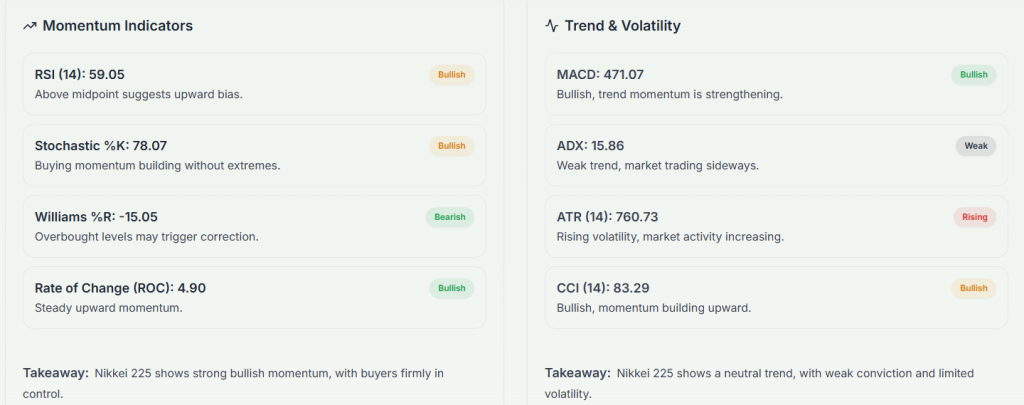
This means chart patterns and trend lines support the idea of continued upward movement in the short to medium term. Broad technical indicators, such as positive moving averages and strong breadth, are consistent with bullish sentiment.
What Meyka says about the recent surge?
Meyka’s analysis notes that political clarity from the election played a pivotal role in the strong gains. Markets reacted not just to the headline index move but to the implied stability and expected policy continuity. This aligns with broader sentiment that investors prefer certainty, especially in periods of global volatility.
How do other analysts view the Japan Stock Market outlook?
External analysts point out that while the rally is strong, some of the gains reflect future expectations rather than immediate economic changes. Persistent high valuations can lead to volatility if political promises are not backed by substantive fiscal action. However, many strategists still see room for upside if corporate earnings and global growth remain supportive.
What Investors Should Watch Next in the Asian Stock Market?
Will the Nikkei stay above record levels?
Key drivers going forward include:
- Actual policy announcements from Takaichi’s government
- Corporate earnings reports in key sectors
- Global interest rate signals (especially from the U.S. Federal Reserve)
Investors should watch whether the index can hold above historical highs or if profit‑taking emerges after the sharp rally.
What macro data matters?
U.S. jobs, inflation figures, and central bank decisions will influence risk sentiment globally. Strong macro data from major economies can support markets, while weak data might prompt caution. Asian markets are also sensitive to China’s economic data, commodity prices, and currency movements.
Wrap Up
Japan’s Nikkei 225 rally above 57,000 on February 9, 2026 stands as a clear example of how political clarity can drive market momentum. The strong Takaichi trade reflects expectations of policy continuity, fiscal support, and improved investor confidence.
While the rally is supported by broad gains across Asian markets and strong technical signals, future performance will depend on actual policy implementation, earnings strength, and global macro trends. Traders and long‑term investors alike should monitor these evolving factors, as the interplay between politics and markets continues to shape Asia’s financial landscape.
Advertisement
Frequently Asked Questions (FAQs)
On February 9, 2026, Asia stocks rose after Japan’s PM Takaichi won a strong majority. Investors felt confident her government would follow stable, growth-friendly policies, boosting stock demand.
The Nikkei 225 passing 57,000 on February 9, 2026, shows Japan’s stock market is very strong. It reflects investor optimism and hopes for stable policies and economic growth.
Following Japan’s surge on February 9, 2026, markets in South Korea, Hong Kong, China, and Australia also rose. Investors are encouraged by Japan’s political clarity and global market optimism.
Disclaimer:
The content shared by Meyka AI PTY LTD is solely for research and informational purposes. Meyka is not a financial advisory service, and the information provided should not be considered investment or trading advice.
Advertisement
What brings you to Meyka?
Pick what interests you most and we will get you started.
I'm here to read news
Find more articles like this one
I'm here to research stocks
Ask our AI about any stock
I'm here to track my Portfolio
Get daily updates and alerts (coming March 2026)