











In March 2026, two giants of the tech world made a bold move in the AI hardware race. Samsung Electronics and Advanced Micro Devices agreed to expand their partnership around next‑generation memory technology.
At the heart of the deal is HBM4 high‑bandwidth memory, which Samsung will supply for AMD’s upcoming Instinct MI455X AI GPUs. This memory isn’t just faster, it is designed to feed massive amounts of data to AI accelerators without choke points, a key bottleneck in today’s systems. With AI workloads growing rapidly, this collaboration could reshape how data centers and cloud providers build future‑ready infrastructure.
Why Memory Bandwidth Has Become a Core AI Bottleneck?
AI chips are judged by more than just raw compute power. Today, memory bandwidth, the speed at which memory moves data, is equally critical. Many machine learning models push massive volumes of data between memory and processing cores. If memory cannot supply data fast enough, even a powerful GPU will underperform.
High‑Bandwidth Memory (HBM) was designed to solve this. It stacks many DRAM chips vertically and connects them with very wide interfaces. Compared with traditional GDDR or DDR memory, HBM delivers several times the data throughput in the same physical space. This makes it ideal for AI training and inference workloads that constantly feed large amounts of information to compute units.
As AI model sizes grow, the demand for higher data throughput and lower latency is rising. This trend is now pushing memory technology to evolve just as fast as GPU architectures. HBM3E, the latest mainstream generation, already offers huge bandwidth, but pioneers in AI infrastructure see next‑generation HBM4 as the key to future performance gains across leading GPU accelerators.
How Samsung HBM4 Enhances AMD’s Next‑Gen Instinct MI455X?
What Is Samsung’s HBM4 Memory?
Samsung’s HBM4 is the sixth‑generation high‑bandwidth memory standard intended to power the next wave of AI accelerators. It builds on JEDEC’s official HBM4 specification finalized in April 2025, supporting data transfer rates up to 8 Gb/s per pin and bandwidth figures surpassing prior generations.
Key capabilities include:
- A stacked memory architecture that increases data paths per stack.
- Gigabytes‑scale capacity per stack to support large AI models.
- Much higher bandwidth than HBM3E and older designs.
These features help GPUs access essential data quickly, reducing bottlenecks that slow down large‑scale AI computations.
Why Samsung HBM4 Matters for MI455X?
Advanced Micro Devices’ MI455X is positioned as a flagship AI GPU in the Instinct series. While AMD has not published all official specs, community data suggests it may target 432 GB of HBM memory with around 19.6 TB/s of bandwidth for peak performance.
By pairing MI455X with Samsung’s HBM4, AMD aims to unlock:
- Higher raw data throughput than previous Instinct generations.
- Better scaling for large AI models during training and inference.
- Enhanced efficiency in data center environments where throughput per watt matters.
The deal also reinforces Samsung’s role as a primary memory partner for AMD’s GPU roadmap, after earlier collaboration on HBM3E for accelerators such as MI350X and MI355 variants.
What does the Samsung‑AMD Memory Partnership Really Mean?
How the Deal Strengthens AI Supply Chains?
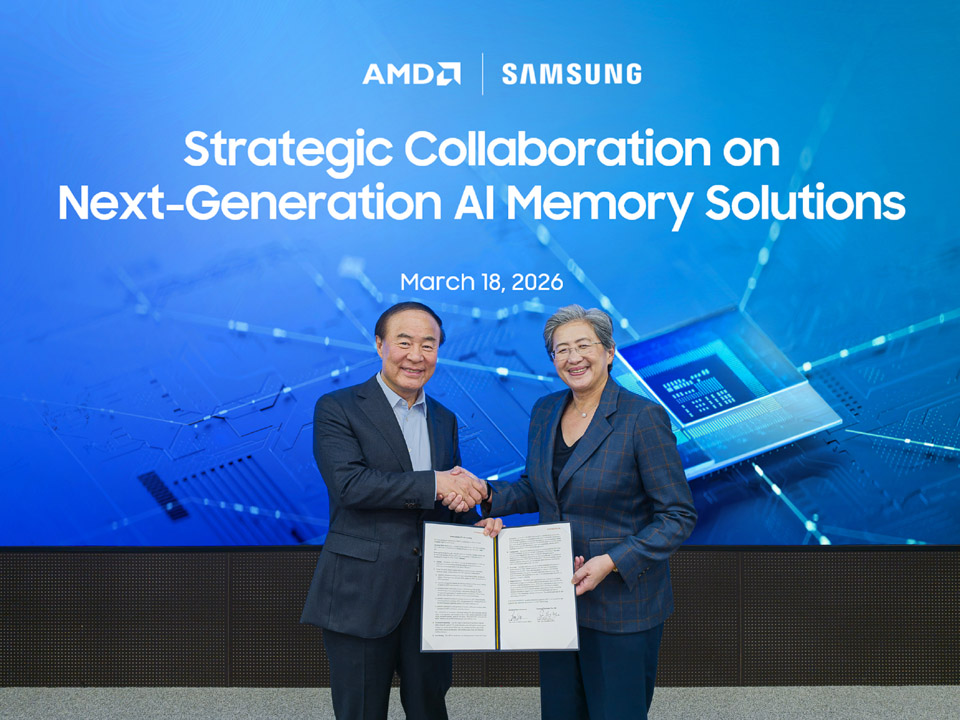
On March 18, 2026, Samsung and AMD signed an expanded Memorandum of Understanding (MoU) to deepen collaboration on next‑generation AI memory and compute technologies. Under this agreement:
- Samsung will prioritize the supply of HBM4 memory for AMD’s Instinct MI455X GPUs.
- The companies will also work on optimized DDR5 memory for AMD’s next‑gen EPYC server CPUs.
- Exploration of future foundry services and advanced packaging cooperation is included.
This deal is not just about selling chips. It aligns memory, GPU, and CPU supply chains tightly, reducing the risk of bottlenecks in global AI hardware deployments.
How does this compare to Industry Moves?
Samsung’s expanded role contrasts with memory leadership from competitors like SK Hynix, which is also heavily investing in HBM4 capacity and new equipment to stay competitive. HBM4 has become a focal point in the AI memory race, with aggressive capital expenditures and equipment orders in recent weeks.
In addition, industry data indicates that memory shortages and yield issues are still a challenge for global AI hardware production. These pressures heighten the importance of solid supply agreements like the one between Samsung and AMD.
What does this partnership signal for AI Hardware Progress?
Is Memory Becoming More Important Than Compute?
In many AI workloads, memory bandwidth can limit performance more than raw compute power. A GPU with very high FLOPS but slow memory will struggle to feed data fast enough. This makes next‑gen memory like HBM4 essential to actually realize compute potential. Analytics platforms and AI stock tools show that investors and engineers alike are now ranking memory tech as a driver in AI hardware performance.
Will MI455X Compete With Other AI GPUs?
Early calculations from technical communities suggest MI455X’s spec targets could rival next‑generation accelerators from competitors, especially when paired with cutting‑edge memory. Real‑world performance will depend on final memory speeds, stack configuration, and integration in complete systems.
However, securing a reliable HBM4 supply and deepening partnership with Samsung gives AMD a strategic edge. It reduces dependency on a single memory supplier and strengthens AMD’s position in the AI infrastructure market.
Real‑World Signs This Is Materializing
- Multiple high‑authority outlets reported the Samsung‑AMD MoU signed on March 18, 2026, as a key strategic move for AI memory supply.
- Samsung is starting volume shipments of HBM4 memory, positioning itself for broader adoption.
- Analysts point to memory constraints and wafer supply stress across AI hardware providers, making expanded memory partnerships more valuable.
What Comes Next for AMD and Samsung?
The partnership is still unfolding. Both companies are in validation and early qualification phases of HBM4 production. This means real product shipments will likely scale throughout 2026.
Beyond GPU memory, discussions about future foundry cooperation and advanced packaging technologies hint at a broader industry shift. This could change how AI chips are designed, made, and deployed at scale in data centers, with memory specialization at the core.
As AI workloads grow and memory demands rise, this deal might set a blueprint for future hardware collaborations. Precise performance and adoption timelines will become clearer as products reach customers and systems integrators.
Conclusion
Samsung’s HBM4 memory deal with AMD for the Instinct MI455X is a major strategic development in the AI hardware landscape. It highlights the growing role of advanced memory in real‑world performance and ties AMD’s future GPU roadmap to a robust memory supply.
As memory bandwidth becomes increasingly pivotal, this partnership could influence how data centers and cloud providers deploy next‑generation AI systems. Continued advancements and industry adoption throughout 2026 will determine its long‑term impact.
Disclaimer:
The content shared by Meyka AI PTY LTD is solely for research and informational purposes. Meyka is not a financial advisory service, and the information provided should not be considered investment or trading advice.
What brings you to Meyka?
Pick what interests you most and we will get you started.
I'm here to read news
Find more articles like this one
I'm here to research stocks
Ask our AI about any stock
I'm here to track my Portfolio
Get daily updates and alerts (coming March 2026)